Microbial Biodiversity in Agriculture: Why It Matters
Microbial biodiversity analysis for agriculture and environmental systems
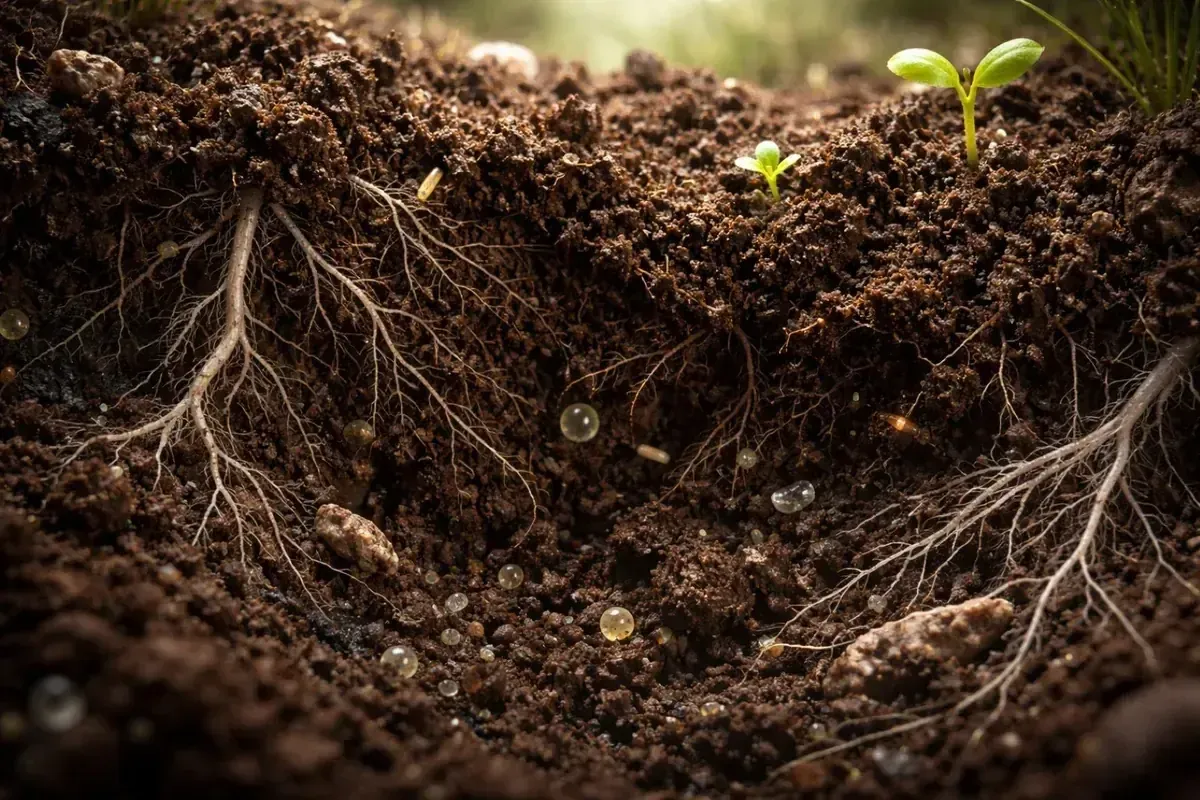
Biomcare helps agricultural and environmental R&D teams measure, understand, and compare microbial biodiversity using sequencing-based methods and advanced statistics.
We support projects where biodiversity data is used to:
- •Evaluate farming practices and sustainability initiatives
- •Compare treatments, management strategies, or field conditions
- •Document environmental impact and biological effects
- •Monitor changes in microbial communities over time
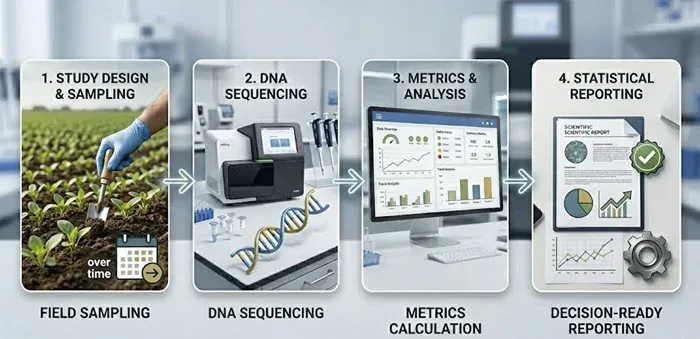
Our work covers the full workflow – from study design and sampling guidance to sequencing, biodiversity metrics (alpha diversity, richness, evenness), statistical testing, and clear, decision-ready reporting.
Whether you work with soil health, regenerative agriculture, biostimulants, or environmental monitoring, Biomcare provides scientifically robust biodiversity analysis that can be directly used in research, product development, and documentation.
Background: Microbial Biodiversity in Agriculture
Biodiversity is critical to the health and sustainability of our planet's ecosystems, including agricultural systems. Monitoring and measuring biodiversity in agriculture can help us understand the status and trends of the diversity of living organisms within a given ecosystem, and how that diversity is affected by agricultural practices.
Sequencing technologies can be applied to identify the microbes in a sample and calculate the diversity of its microbiome community. When we do so, we talk about "alpha diversity". See more below on how we calculate alpha diversity as a measure of biodiversity or biotic diversity.
Why Monitor Biodiversity in Agriculture?
Biodiversity underpins the health, productivity, and resilience of our agricultural systems. Here's why tracking it matters:
Ecosystem Health
From soil microbes to pollinators, biodiversity powers the ecosystem services agriculture depends on - soil fertility, pest regulation, and nutrient cycling. When biodiversity declines, these services break down, reducing yields and driving up reliance on synthetic inputs.
Sustainability
Biodiverse systems are more productive and resilient over time. Without it, farms become more susceptible to pests, disease, and soil degradation. Monitoring biodiversity helps us identify harmful practices early and shift toward approaches that sustain productivity long-term.
Food Security
Genetic diversity in crops is our insurance against climate shifts and disease outbreaks. Diverse agroecosystems also mean a broader range of foods - essential for feeding a growing global population with varied nutritional needs.
Climate Change
Diverse plant communities capture more carbon, making biodiversity a natural ally in reducing emissions. Measuring it helps us understand which agricultural practices contribute to - or undermine - climate mitigation.
Policy & Decision-Making
Good policy starts with good data. Understanding biodiversity trends gives decision-makers the evidence they need to guide land use, conservation priorities, and sustainable farming practices.
Sequencing methods to measure biodiversity
In its simplest form, biodiversity describes the number of different living organisms in a system. But this is only one of a range of measures for biodiversity that can be calculated from sequencing data.
At Biomcare, we use sequencing to study diversity, and based on the sequencing data calculate different biodiversity measures to evaluate the diversity from different perspectives. However, they all fall within one of the following groups:
- •Richness – the number of different species in a given sample
- •Inferred richness – the number of different species in a given sample, when considering the organisms that we did not detect due to technical limitations.
- •Evenness – the degree to which the relative abundances of the different species in the sample are similar
- •Combination of richness and evenness – that is measures that consider both richness and evenness
At Biomcare we calculate several different measures to cover the different interpretations and make sure we fully elucidate the properties of the biodiversity in a given sample. When we have calculated alpha diversity, we apply statistics to understand if the diversity is significantly different between conditions or associated with an external factor of interest.
The sequencing methods used dictate what part of the community is studied:
- •Amplicon methods (aka. Metabarcoding) – capture a subset of the microbiome depending on the genetic region that is sequenced e.g. bacteria with 16S and fungi with ITS. Amplicon sequencing allow us to consider all detected microbial entities based on the code of the genetic region and therefore allow us to include microbes that are unknown or are not found in reference databases. Therefore, the diversity measure obtained using amplicon is often higher than the measure obtained with shotgun metagenomic data where the diversity measures represent the diversity of known organisms.
- •Shotgun metagenomic – capture all living organisms only limited by their abundance (the more data we generate for a sample the lower abundant organisms will be captured). We can therefore get a picture of the diversity that include cross-kingdom taxa such as both bacteria and fungi, however for diverse communities a deep sequencing is needed to capture the full diversity. To identify microbial entities with this data we rely on reference databases, and consequently the diversity measure only represents the diversity of known microbes. Note there are exceptions to this rule, where for low complexity samples we can use reference-free processing and capture unknown organisms.
To complicate things, biodiversity can be analyzed using several other techniques. Each technique capture an aspect of diversity and they are often not directly compatible. It is therefore important to consider which methods is used and what information or aspect of biodiversity it provides.

The concept of biodiversity
Biodiversity can describe the diversity of living organisms in a larger environment like the ocean, in a more specific location like a lake, field, or forest, but also the diversity of a type of organisms like plants, fishes, or microorganisms. Biodiversity can also broadly describe the general variety of life on earth through different ecosystems on the planet, such as deserts, rainforests, and coral reefs. Furthermore, biodiversity considers the diversity within a species, such as its genetic diversity and many dimensions must thus be considered when fully assessing biodiversity.
Therefore, what is exactly meant by biodiversity depends on the connection in which the term is used.
People concerned with the quality of freshwater lakes will discuss the diversity as the number of different fish in the water and perhaps include information on the total number of fish. Or they will discuss the number of different microorganisms in the water well knowing these tiny living organisms are important indicators for the quality of the water.
Microbiome analysis scaled to your needs.
Are you looking for a partner that brings your microbiome analysis from A-Z with experience and confidence?
Then Biomcare is the right match for you.
We offer the full process from design to results, and you can choose to have our support for the full process or just the steps you need.
This process is developed specifically for commercial R&D and academic research that implement microbiome or microbe analysis as part of projects or service solutions.
Get started
Talk to our team about your biodiversity analysis needs.
Biodiversity and sustainability
The term biodiversity will often be heard in connection to discussions of sustainable farming, pollution, and climate changes. This is because pollution and climate change are known to reduce the diversity of living organisms on the planet, and in environments like the soil and water. Biodiversity enhances the productivity of an ecosystem – because each species, no matter how small, has an important role to play.
In ecology, involving the interaction between living organisms, concepts such as cooperation and competition are important and we recognize how "survival of the fittest" is important to keep a balanced ecosystem. Despite the competition between species, each species depend on the services provided by others to survive. Appropriate conservation and sustainable development strategies, therefore, recognize the need to preserve and increase biodiversity.
Declining biodiversity is a concern for many reasons. In recent years the reduction in the diversity of insects has been a highly discussed topic, especially with a focus on the reduction in the number of bees due to high usage of pesticides.
Pollinators are essential to both biodiversity and food production. FAO highlights that three out of four crops producing fruits or seeds for human use depend, at least in part, on animal pollinators.
Pollinators represent one of the most visible examples of how biodiversity underpins ecosystem function and agricultural productivity. However, many of the same principles apply below ground. Soil microbial communities play a fundamental role in nutrient cycling, soil structure, and plant health, and changes in farming practices can strongly influence this hidden but critical component of biodiversity.
Understanding biodiversity therefore requires attention not only to above-ground organisms, but also to the microbial communities that regulate key ecosystem processes and support sustainable agricultural systems.
Humans are using an increasing fraction of the earth's surface for farming. While this is necessary to feed the growing population, it is also causing serious risks to our ecosystems and the biodiversity of the nature around us. When a single crop is grown on a field, the diversity of the field is drastically reduced. As a consequence, many plants that are not used for human or animal food, but which are important for our ecosystem, are having a hard time finding a place to grow.
This reduces both the diversity of plants and insects, as well as bigger animals living wild in nature, as their natural habitats are reduced. But also, the diversity of the smaller organisms, the microorganisms in the soil, is suffering. The fertilization, use of pesticides, and intense usage of the soil cause the diversity of microorganisms to decline. This has the critical consequence of reducing the health of the soil and its ability to support the production of plants for food for the world's larger living beings.
Biodiversity is key for agriculture
The interaction between soil, plants, and microorganisms, including bacteria and fungi, is fundamental for the plant's ability to take up nutrients from the soil. In turn, the diversity of microorganisms in the soil is key to effective agriculture. Soil degradation by pollution, depletion, contamination, salinization, etc., destroys the habitat of soil organisms and causes soil biodiversity to decrease. Key factors of management practices that reduce soil diversity include reduced deposition of organic matter and the sidestep of naturally occurring nutrient cycling by microorganisms.
One key example of the importance of soil biodiversity is the role of microorganisms in the nitrogen cycle. Nitrogen is found in the environment in several different chemical forms such as organic nitrogen, ammonium, nitrite, nitrate, or inorganic nitrogen gas. Organic nitrogen is found in living organisms such as plants and animals, in humus, or intermediate products. In the nitrogen cycle, nitrogen is transformed from one form to another, and many of those transformations are carried out by microbes. Microorganisms carry out the processes of transforming nitrogen for their benefit, but the processes are essential for the cycling of the important building block. Of key importance to farming is the breakdown of the nitrogenous components in animal urine by nitrifying bacteria in the soil so that the nitrogen can be used by plants.
Ready to measure biodiversity in your project?
Whether you're evaluating farming practices, comparing treatments, or documenting environmental impact, we start with a practical consultation focused on your objectives.