Soil Microbiome Analysis & Microbiome Profiling
Know what's in your soil-test for microbes and functional capacity
Microbiome profiling adds the layer that standard soil tests miss: which microbes are present, and what they are capable of. Our Soil Biology Test deliver exactly that - as a clear, structured report designed for monitoring and documentation.

This page has been reviewed for scientific accuracy by Migle Gabrielaite, PhD in Bioinformatics. Last updated: March 2026.
View her published research on Google Scholar →


 UNIVERSITYHospital of Aarhus





 University of AarhusSEGESInnovationUNIVERSITYHospital of AarhusUniversity of AarhusSEGESInnovation
Make soil biology visible
Soil testing is a foundation for crop performance and risk management-microbiome profiling adds the biological layer: who is there and what can they do.
Track change over time
Use the same test across seasons, fields, or inputs (manure/compost) to see how microbial communities and functional capacity shift.
Clear results, not technical overload
A consistent, readable report designed for growers and operational teams.
What nutrients don't tell you about soil biology
Most soil decisions rely on chemistry and history. But soils can behave differently even when nutrient levels look similar-because microbial communities differ in composition and functional capacity.
In a context of climate variability, increasing regulatory pressure, tighter margins, and gradual soil degradation, relying on nutrients alone is no longer enough. Biological function increasingly determines resilience, disease pressure, input efficiency, and yield stability.
Microbiome profiling tells you what's in the sample and what biology is likely available (based on genes), so you can:
- Know the biological health of your soil and identify bottlenecks early
- Document baseline conditions and track real change over time across fields and time points
- Monitor inputs like manure or compost and reduce unnecessary inputs by understanding what your soil already supports
- Support internal, regulatory, or investment-related discussions with structured data
In today's farming reality, biological insight is no longer academic - it directly influences input cost efficiency, yield stability, and long-term land value
Who this is for
Growers and farm managers
One reliable test for pre-season baselines, post-intervention monitoring, or tracking change over time - especially useful when transitioning to regenerative practices or investigating unexplained yield variability.
Advisors and field networks
Comparable results across farms and seasons - an objective biological layer when field performance differs despite similar nutrient plans or crop histories.
Product teams monitoring organic inputs
Consistent profiling of microbial composition and functional capacity in manure, compost, or soil amendments - critical when biological inputs perform inconsistently across sites.
If you are planning to perform consistent, longitudinal sample collection to track changes or understand the effect of specific additives or actions, consider contacting Biomcare to discuss your plans. We support projects with consulting on design, sampling, and perform the needed statistical analysis to compare samples. See more under Study & Trial Support for Soil and plant.

"Biomcare's advanced expertise and user-friendly analytical approach have significantly enriched our microbiome research. We highly recommend them to anyone seeking high-quality DNA sequencing and data interpretation."
Tove Mariegaard Pedersen
Special Consultant, MSc in Biology
Innovation Center for Organic Farming
Select the right Soil Microbiome analysis test for you
THE DEFAULT Soil Microbiome Test
This is the "A-test" most customers want-simple to order, consistent output, and designed for repeat use.
What it measures
- Taxonomy: which microbes are present (community composition)
- Functional capacity: what key microbial functions are encoded (gene-based capacity, not activity)
- Selected agriculture-relevant functions: a focused functional feature view that turns complex gene data into readable categories (without overwhelming the user)
A note on scope
- This is a biological measurement tool - it tells you what's present and what functions are encoded. It works alongside your agronomy, not instead of it, and does not generate yield promises or management prescriptions.
Alternatives and add-on solutions
If you need a different fit for purpose, we can adapt the approach. We have a range of technologies available for microbiome profiling each with their different advantages. The default is a comprehensive method that is most often a good choice, but we can discuss alternatives if you have some specific needs or requirements.
When may you want to consider an alternative?
- You are mainly interested in a biodiversity metric- for example to support sustainability reporting, regenerative transition documentation, or ESG-related assessments.
- You want high sensitivity fungi profiling
- you mainly need community composition trends for a single group of microbes (bacteria, fungi).
We also have some add-on options to both the default and alternative solutions. These include adding a test for absolute microbial load that allow us to turn the default relative-abundance type profiles into absolute values.
Read about the different technologies under the menu Technology.
How it works
Contact us, then collect and ship your sample(s)
Get in touch to let us know you are sending samples. We will send you shipping instructions, a sample sheet, and a label guide. For soil, collect 8-16 subsamples across the field, mix them in a clean bucket, and transfer 3-4 ml into a clearly labeled container. See our step-by-step soil sampling guide for details. For other sample types, contact us to discuss the best approach.
We process the sample(s)
We handle soil, root, plant, and seed matrices with robust, reproducible workflows. You send us your sample - we take it from there.
You get the results
You receive two reports: one on the taxonomic composition of your sample(s), and one summarising selected agriculture-relevant functions. Full underlying data tables are available on request. For multiple samples or ongoing projects, we set up a project folder where you can access all data, reports, and information at any time.
What you get
Clear Soil Microbiome reports
Community overview (who is there)
Selected agriculture-relevant functional feature view
(readable, focused categories)
Supplementary large tables if requested
The full Functional capacity overview (what's encoded) and full Community overview (who is there)
How our clients use this service
Establish a baseline before a new season or a major change in practice
Compare two fields with similar soil chemistry but different performance
Monitor the microbiome signal before/after organic amendments (manure/compost)
Track how soil biology changes across seasons, crop rotation phases, or input strategies
Add a biological layer to internal documentation or partner conversations
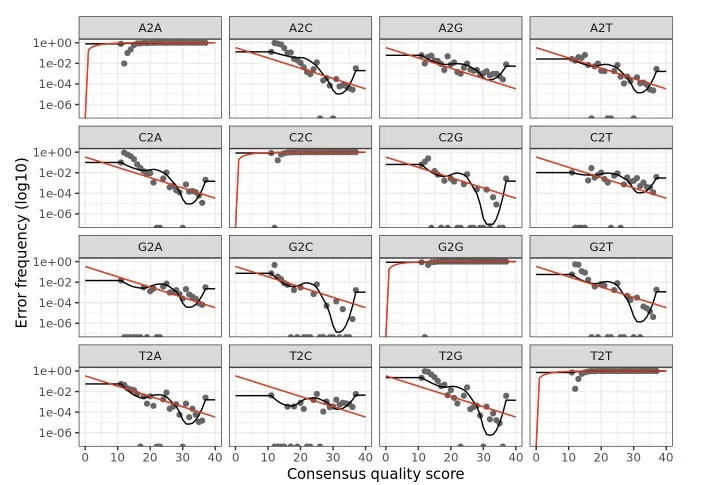
Figure: Microbiome profiling - Calculation of error rates
Why Biomcare
Many microbiome outputs are hard to use because they are either too technical-or over-interpreted.
Biomcare focuses on:
Accurate measurement + structured reporting
(what is present; what functions are encoded)
Consistency for monitoring across time and sites
Transparency: full underlying data always included
Options without complexity
one default test, plus upgrades when needed
Ready to test your soil?
Order a Soil Microbiome Test or talk to a specialist about your use case.
Typically responds within 1 business day
Why soil microbiome analysis matters
Soil microbiome analysis helps identify the microorganisms present in soil and understand their potential role in plant health, nutrient availability, and crop performance. Because microbial communities vary with soil type, pH, water content, fertilization, and crop type, profiling the soil microbiome can provide valuable insight for agricultural research and product development.
At Biomcare, soil microbiome analysis, or Microbiome profiling, can be used to detect beneficial and harmful microorganisms, explore links between microbial composition and agronomic outcomes, and support documentation of new farming solutions. Depending on the project goals, analysis may help evaluate microbial patterns related to crop yield, plant health, or soil conditions.
Ready to run your Soil Microbiome Test?
Start with the standard test for a clear baseline of microbes and functional capacity. If you have a specialised use case (many samples, specific targets, different matrices), we'll recommend the best option before you commit.

Quick Contact
Email us at
info at biomcare dot comCall us at
+45 31 57 20 81We typically respond within 24 hours on business days.